Leave it to LizRetros to come up with new ways of keeping treasured dolls spoiled. For her new line of shoes now expands to fit a range of 1/6 fashion dolls. Perhaps, this long weekend is the time to take inventory and finally get shoes to replace missing ones or to give a beloved classic more glamour! From solid colors to powerful animal prints, the mouth-watering selection (all have red soles - a nod to monsieur Louboutin) is sure to make decisions difficult!
Anouk by Nav Sikand chooses pink leopard to complement her "Berlin" cocktail look.
A vintage high-color American Girl Barbie opts for classic black for her classic brocade sheath. The Sears exclusive mink coat was reproduced with recycled fur by Sylvia Campbell.
Mamzelle de Paris' Sophine has fun in a sheath by LizRetros and golden leopard heels. Necklace by Joy Jarred.
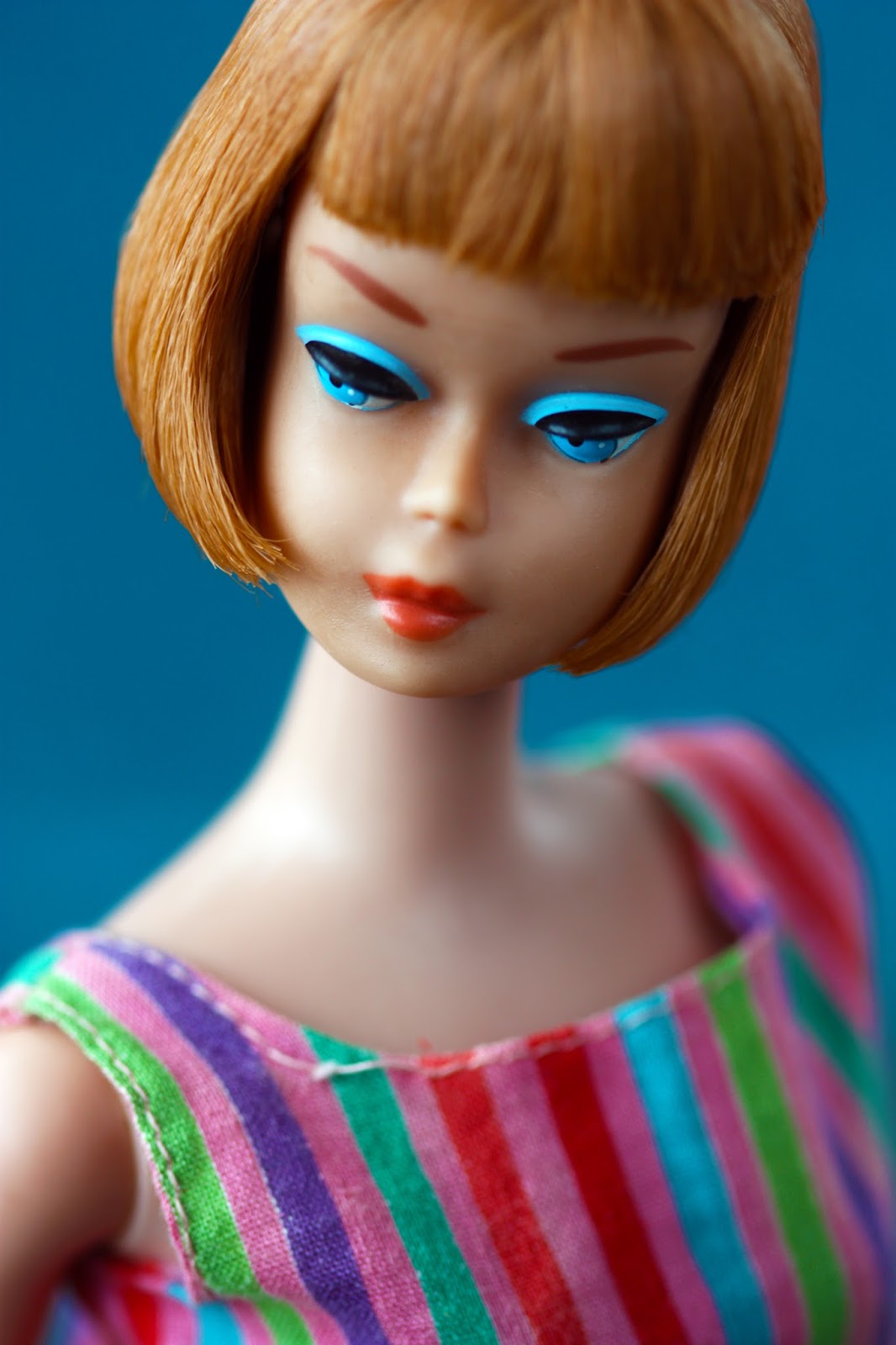
Fifty years ago, the American Girl Barbie doll (stock # 1070) debuted a new bobbed hairstyle and bendable legs in one of Mattel's swingiest television commercials: "The Barbie Look"
"Here are five of your favorite friends,
Barbie,
Midge,
Skipper,
Allan,
and Ken
But if you think they're the same
As they've always been
You better take another look,
Better check them again!
Now you can see that they've all acquired
A brand-new look that's Barbie inspired!
Designers call this The Barbie Look,
This great new fashion look.
And these bendable legs really look so natural
And the way that they move is so lifelike,
That you'll really be amazed at all the things they can do,
And they way that you pose them it's up to you!
You can seat them on a sofa or the edge of a bed
Or you make them sit right on the floor instead
They can cross their legs and relax and while
Or sit down to dinner in formal style.
You can pose them together in dozens of ways,
You can even have them dancing the latest craze.
You can put them in a really swinging pose,
And they look so graceful in all their clothes,
And that is just part of the fashion look,
The great new Barbie Look.
You'll get Barbie, Midge, Skipper, Allan, and Ken
And the Go-Together furniture to sit them in,
And you'll find them all where the best toys sell!
You can tell they're Mattel, they're swell!"
Bendable legs had been introduced the previous year with the sleep-eyed Miss Barbie doll. Designed to look like human legs, the clicking joints were hidden under a perfectly smooth vinyl skin. But for 1965, Mattel decided to marry this innovation to the soft vinyl head mold with a rooted bob hairstyle (another first), creating a decidedly different look for Barbie. The Bendable Leg Era is also known for the now-iconic and much-coveted "sixteen hundred" line of fashion ensembles (their stock numbers started with the 1600 prefix) that were designed by Charlotte Johnson to take Barbie to new heights of elegant luxury. In a stroke of pure marketing genius, Mattel also released Go-Together furniture sets so that its famous teenage fashion model could have plenty of chairs, sofas, swings, and recliner chaises to show off what she could do with her newly acquired articulation
To Dolldom, the American Girl Barbie is the most beautiful iteration of the doll that uses the original Barbie face. Be it as a low color, pale-lipped girl-next-door or as a high color Technicolor sophisticate, the American Girl Barbie has unequivocal magic and veritable chic. Produced for only two years, the bendable leg American Girl Barbie would soon disappear (many were traded in for the new Twist and Turn model) but her allure lives on as this Dolldom celebration illustrates.
The art of fashion design is appreciated and valued for its attention to detail, careful execution, and originality: all the qualities that exemplify early Barbie style. The interesting dichotomy of the Barbie doll lies in the fact that in spite of being the triumph of vinyl rotation and other advances of mid-20th century technology, the origins and creation of her wardrobe are rooted in a tradition of craftsmanship. A little more than five decades ago, a considerable amount of handcrafting went into the production of the Barbie doll’s ensembles - in Japan. The hands of many Japanese factory workers and freelance seamstresses who worked from their homes collaborated to conceive a product unlike anything seen at that point in toy history. The reduction of scale and the mastery with which the details were achieved, guaranteed the success of the Barbie doll line. Which is why many collectors aspire to possess such examples of sartorial precision.
Vintage photo showing Tammy and Barbie doll displays at a Japanese store.
Sylvia Campbell has been designing reproductions for the Barbie doll under the Snowdance Fashions label since 1996. A professional seamstress and a veteran of studio as well as motion picture work, Sylvia now devotes her full attention and efforts to the replication of the most elusive: rare designs created for the Japaneses market - many of which were meticulously researched and documented by Keiko Kimura Shibano in her book Barbie in Japan, published by Murat-Caviale and photographed by the great Barry Sturgill.
Cover of Barbie in Japan by Keiko Kimura Shibano
Sylvia’s aim is to create a perfect miniaturization using high-quality fabrics and embellishments -sometimes from the same vintage - with the same degree of precision and beauty achieved by Japanese hands more than five decades ago. After sourcing the materials, Sylvia creates the patterns, many times using the original garment. This incredible dedication and attention to minutiae enable Sylvia to recapture that delicious vintage feeling.
In this exclusive feature, Dolldom profiles Sylvia's masterful execution of kimonos for Barbie, her sister Skipper, and her cousin Francie Fairchild. To close the fashion extravaganza, a magnificent re-imagining of a rare gown shown on page fifty of Miss Kibano's tome. Dolldom applauds Sylvia Campbell for her ongoing dedication to providing collectors with the opportunity to enjoy the beauty of these rare and hard-to-find treasures. For thanks to Sylvia Campbell, admirers of this exquisite period in the Barbie doll's history are able to travel through time.
The red lace kimono with gold brocade obi is one of Sylvia's classics for the Francie doll, modeled in this photo by a Japanese market doll.
Barbie's sister, Skipper enjoys Sylvia's attention. Miss Campbell fashioned this yukata from a perfectly scaled cotton print that evokes the blooming wonders of a Japanese spring. It is modeled by a OOAK Skipper doll re-rooted by Angie Gill. Skipper's doll case by Rebecca Brosdahl.
Authentic silk crepe, named chirimen and used for kimonos in Japan is one of Sylvia's fantastic fabric finds. Made in the furisode style with long, draping sleeves, it is worn by an unmarried woman on very special occasions. Patterned and sewn exactly as the kimonos were sewn for Barbie in the 1960’s, this one boasts hand stitching and an obi of gorgeous pink, gold, and mauve brocade. Sylvia used silver and teal soutache braid for the obi-jime cord. Sylvia also created the hair ornament. An undisputed masterpiece.
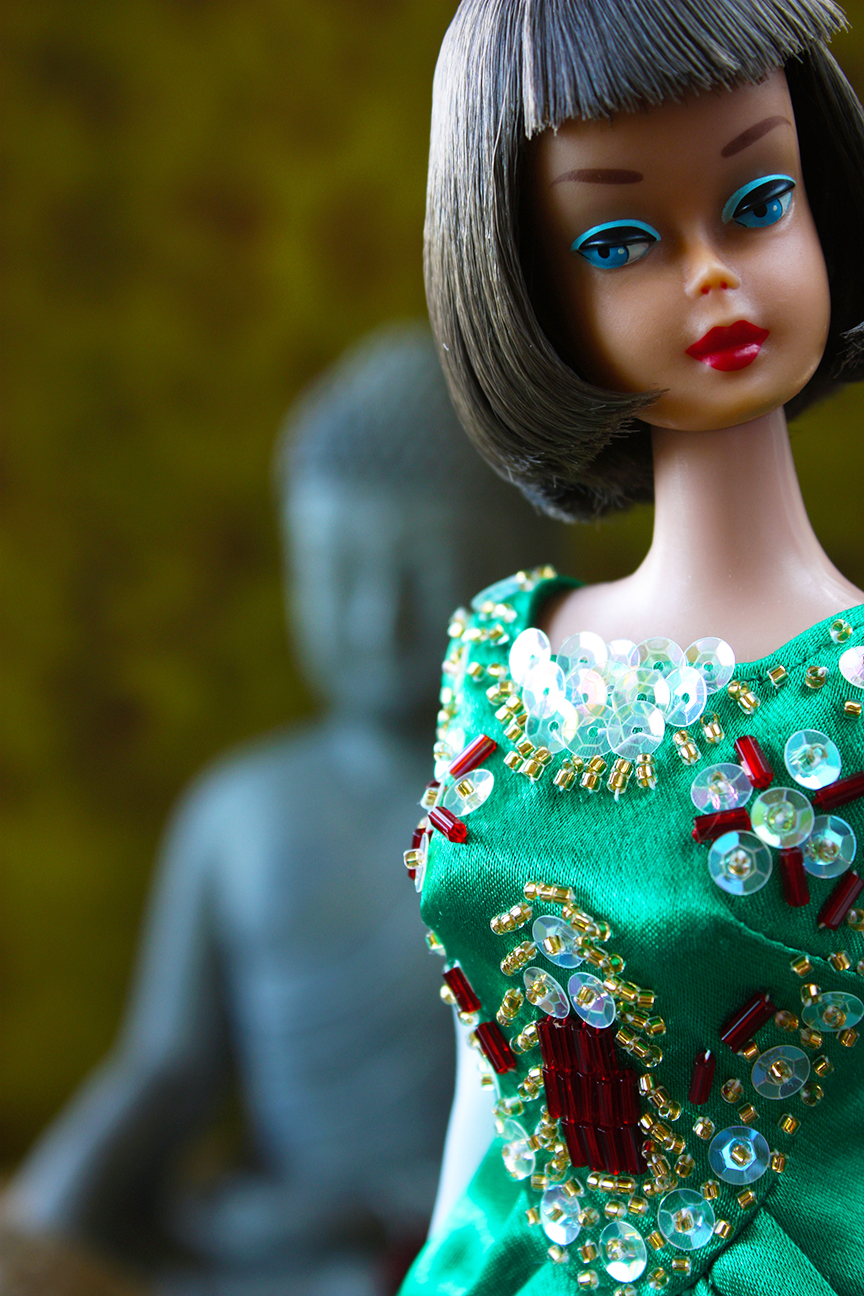
First show on page fifty of Barbie in Japan, this hand beaded dress caught Dolldom's eye and became an obssession. When Sylvia recreated it, there was motive for celebration. Later, Sylvia upped the ante and brought it to the world in emerald - Pantone's color of the year for 2013. The creamy satin silk bodice bedazzles with sequins, red
crystal bugle beads, and 24k gold lined crystal seed beads. Limited to an edition of eight, these gorgeous hand beaded and sequined dresses were cut a little bit
longer than the original beauty, which was lent by one of Sylvia's loyal friends, so that she could create the pattern.
For more of Sylvia Campbell's treasures, visit her at Snowdance Fashions.
DOLLDOM is a showcase for ideas intended to inspire, amuse, and guide the modern dollector. Fashion, art, décor and gastronomy, it's all here for you and your friends. It's Life Deluxe, DOLLDOM style.
Copyright
All of my images are copyrighted Ernesto Padró-Campos.
Please do not use my images without my permission.






 Posts
Posts


